
Programme objectives

Lorem ipsum dolor sit amet conseteur.
Lorem ipsum dolor sit amet conseteur.
Lorem ipsum dolor sit amet conseteur.
Lorem ipsum dolor sit amet conseteur.
Lorem ipsum dolor sit amet conseteur.
Lorem ipsum dolor sit amet conseteur.
Programme objectives
Lorem ipsum dolor sit amet conseteur.
Lorem ipsum dolor sit amet conseteur.
Lorem ipsum dolor sit amet conseteur.
Lorem ipsum dolor sit amet conseteur.
Lorem ipsum dolor sit amet conseteur.
Lorem ipsum dolor sit amet conseteur.
Programme objectives
Lorem ipsum dolor sit amet conseteur.
Lorem ipsum dolor sit amet conseteur.
Lorem ipsum dolor sit amet conseteur.
Lorem ipsum dolor sit amet conseteur.
Lorem ipsum dolor sit amet conseteur.
Lorem ipsum dolor sit amet conseteur.
Programme objectives
Lorem ipsum dolor sit amet conseteur.
Lorem ipsum dolor sit amet conseteur.
Lorem ipsum dolor sit amet conseteur.
Lorem ipsum dolor sit amet conseteur.
Lorem ipsum dolor sit amet conseteur.
Lorem ipsum dolor sit amet conseteur.
The Mini-Experiment Start-Up©

Fear

Practical knowhow

Simplifies business

Shows people how they can start without the need for money

Empowers people by treating their ideas as a mini-experiment instead of a business
The Mini-Experiment Start-Up©
Fear

Money
Practical knowhow
Simplifies business
Shows people how they can start without the need for money
Empowers people by treating their ideas as a mini-experiment instead of a business
Find Cynthia at
Find Cynthia at
Find Cynthia at
Who are The Rebel school?
When co-founder Alan Donegan went to a traditional business support service to get help with his business idea, the experience almost put him off starting a business. And he doesn’t mind us saying he is white, middle-class, private school educated, has loads of ideas, is very resourceful, and has a supportive family. If the traditional approach puts this guy off, imagine what it does for the rest of us!
The Rebel School was born
In 2008, Alan’s three-page letter of complaint landed on the desk of Glenn Atherfold, the guy responsible for procuring the Business Link service on behalf of the government in the south-east. The managing director of Business Link, a lovely lady called Deborah received the letter from Glenn and walked around the office one bright September afternoon, looking for a fall guy. Yes she needed someone to go and deal with this difficult and slightly unusual complaining customer.
Ah, Simon,” she said finding him skulking in the corner of the office and trying to avoid her eye contact. Later that week co-founders Simon Paine met Alan for coffee in Winchester for what was to become the beginning of a movement to democratise entrepreneurship.
What Simon had predicted would be the worst meeting of the year, turned out to be the best meeting of the decade as they swapped ideas, knowledge and opportunities. Alan shared his experience of business and entrepreneurship and infected Winchester Starbucks with energy and positivity, Simon told him to read Tim Ferriss’ first novel ‘The 4-Hour Work Week’ and shared his experience of Danish business school ‘Kaos Pilot’ and the journey began.
Simon had been coaching grassroots start-ups in disadvantaged communities across the south-east and knew that business plans didn’t help anyone. Alan knew that the only way to know if a business idea was going to work was to sell.

They wanted to set up an alternative business school that was the complete opposite of traditional business schools. To become the only one in the world where you could earn back the cost of tuition in the first few months of attending and instead of paying £25K+ for a piece of paper, you actually make money and leave the school experience with a trading business. They explored sponsorship opportunities with IBM and looked at a couple of buildings but quickly realised that the size of the investment needed meant that they would need money to start.
Programme facilitator
Katie and Alan
We achieved financial independence at the ages of 35 and 40 years old and have had a huge amount of fun over the last 5 years travelling the world and enjoying our time doing cool things with cool people.
We retired 25 years earlier than the UK average and we did it through learning about finance, investing and managing our money.
We learnt about financial independence in 2014 but have been working on self-development and making money for more than 2 decades. Katie was an actuary before she retired and Alan ran Rebel Business School. Alan spent 12 years writing courses on presenting, presence, starting businesses and more. He has delivered workshops for companies like Microsoft, Westminster Council, Oxford University and Henley Business School.
The Rebel School was born
In 2008, Alan’s three-page letter of complaint landed on the desk of Glenn Atherfold, the guy responsible for procuring the Business Link service on behalf of the government in the south-east. The managing director of Business Link, a lovely lady called Deborah received the letter from Glenn and walked around the office one bright September afternoon, looking for a fall guy. Yes she needed someone to go and deal with this difficult and slightly unusual complaining customer.
Ah, Simon,” she said finding him skulking in the corner of the office and trying to avoid her eye contact. Later that week co-founders Simon Paine met Alan for coffee in Winchester for what was to become the beginning of a movement to democratise entrepreneurship.
What Simon had predicted would be the worst meeting of the year, turned out to be the best meeting of the decade as they swapped ideas, knowledge and opportunities. Alan shared his experience of business and entrepreneurship and infected Winchester Starbucks with energy and positivity, Simon told him to read Tim Ferriss’ first novel ‘The 4-Hour Work Week’ and shared his experience of Danish business school ‘Kaos Pilot’ and the journey began.
Simon had been coaching grassroots start-ups in disadvantaged communities across the south-east and knew that business plans didn’t help anyone. Alan knew that the only way to know if a business idea was going to work was to sell.
They wanted to set up an alternative business school that was the complete opposite of traditional business schools. To become the only one in the world where you could earn back the cost of tuition in the first few months of attending and instead of paying £25K+ for a piece of paper, you actually make money and leave the school experience with a trading business. They explored sponsorship opportunities with IBM and looked at a couple of buildings but quickly realised that the size of the investment needed meant that they would need money to start.

What’s new
What’s new
Our story
Partner benefits
Lorem ipsum dolor sit amet conseteur.
Lorem ipsum dolor sit amet conseteur.
Partner benefits
Lorem ipsum dolor sit amet conseteur.
Lorem ipsum dolor sit amet conseteur.
Lorem ipsum dolor sit amet conseteur.
Partner benefits
Lorem ipsum dolor sit amet conseteur.
Lorem ipsum dolor sit amet conseteur.
Lorem ipsum dolor sit amet conseteur.
Lorem ipsum dolor sit amet conseteur.
Partner benefits
Lorem ipsum dolor sit amet conseteur.
Lorem ipsum dolor sit amet conseteur.
Lorem ipsum dolor sit amet conseteur.
Lorem ipsum dolor sit amet conseteur.
Lorem ipsum dolor sit amet conseteur.
Loremipsumdolorsitametconsectetur.
All programmes
The Perfect Business Idea.
Spoiler alert: it doesn’t exist. If you stumble upon a business idea that works flawlessly the first time without any adjustments, brings in money, and you enjoy every moment of it, then I’ll be genuinely impressed. I mean, I’ll be happy for you and might even claim credit for being the person who shared how, but I’ll secretly be a bit annoyed.
Why?
What I’ve come to realize (and wish someone had told me) is that business isn’t an achievement; it’s a process. It’s a way of life that doesn’t solve your problems; it just gives you different ones. Reflecting on 2003, when I started my first business, I began because I believed my problems could be solved if I left my successful career (that’s another story).
What I realized is that the problems needing solving were within me and unrelated to the job I was doing, but again, that’s another story.
So what about the idea itself? Until I started Rebel with Alan in 2011, I did a mix of freelancing, starting businesses, and doing odd jobs in between to pay the bills.
Here are Some Business Ideas That Made It Off the Whiteboard (there are plenty more, but this will give you a good flavor):
Business Idea #1 – Dotcom
- What worked: Cool idea.
- What didn’t work: A bit cumbersome.
- Result: Small profit.
- Key learning: I don’t like admin that much.
Business Idea #2 – Publishing
- What worked: Made a deal that earned me money whether successful in ad sales or not.
- What didn’t work: Advertising sales are highly competitive.
- Result: Small profit.
- Key learning: Sales is about persistence, and you need 10 to 100 times the conversations you think you need to.
Business Idea #3 – Indoor Outdoor Advertising
- What worked: Cool idea; building owners loved it.
- What didn’t work: Didn’t make nearly enough sales calls, focused on the stakeholder, not the client.
- Result: Loss.
- Key learning: Sell first. Don’t give lawyers money unless you have to. Didn’t solve logistics properly – got stuck in detail.
Business Idea #4 – Facilitator and Trainer
- What worked: Already good at this stuff.
- What didn’t work: Didn’t proactively network to expand the client base; a bit lonely; didn’t have a vision.
- Result: Good profit.
- Key learning: Narrow focus to make marketing action clearer; your network is your net worth.
Business Idea #5 – Web Design Company
- What worked: Huge need for it before self-build websites existed.
- What didn’t work: Didn’t make enough money fast enough, and I couldn’t pay my bills.
- Result: Some profit.
- Key learning: Charge buoyantly; spend as much time building trust and being honest with your collaborators as you do building your business.
Business Idea #6 – Enterprise Development in Communities
- What worked: Tested the theory that social housing wanted to help their residents start businesses.
- What didn’t work: Hired the wrong contractor; delivery model didn’t work; geographic area too small.
- Result: Profit.
- Key learning: If you really want to know if it works, don’t dabble – commit.
The Journey to Rebel: A Series of Trials and Triumphs
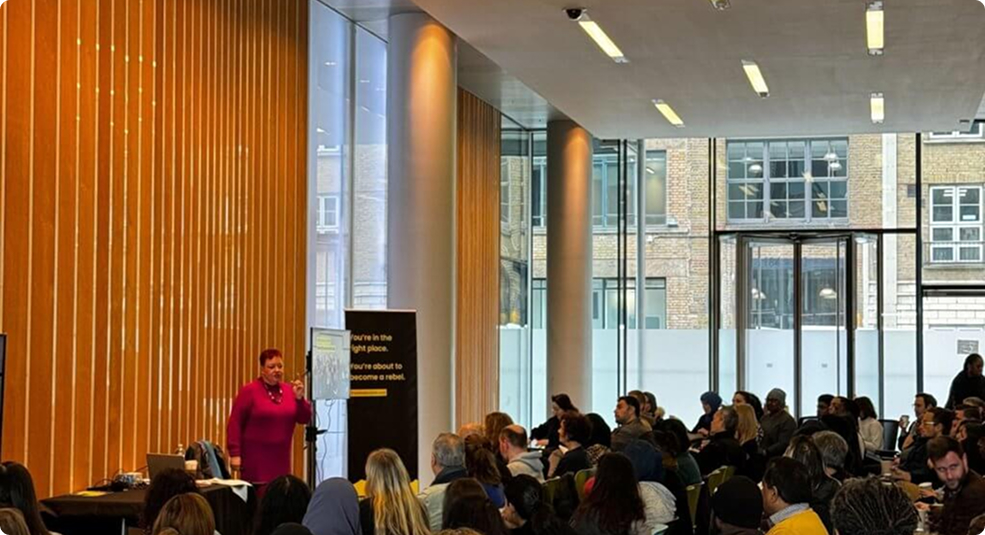
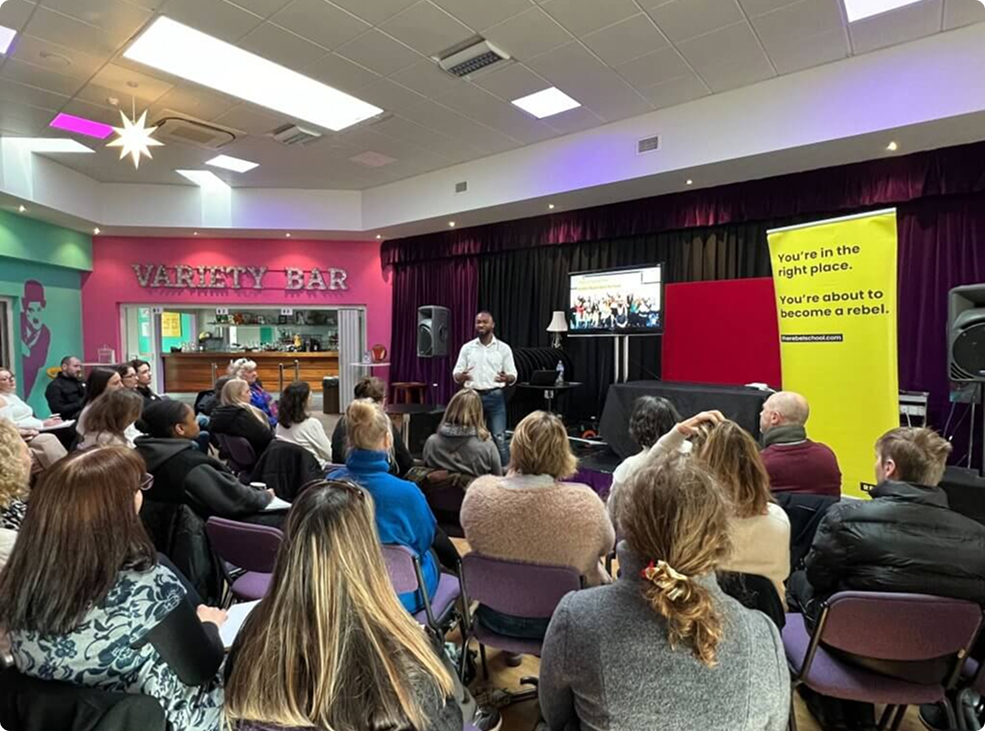
Image caption goes here
Then came Rebel, and writing this has reminded me that Rebel didn’t work the first time either. Not just because of the previous project, but we did a bunch of marketing to 30 housing associations, which only got us one meeting. It was only Alan doing a piece of work for a housing association, teaching their leaders how to present, that gave us the opportunity (now with a bit of trust) to pitch a community business school idea to them. They loved it, and the rest is history.
Everything Starts With the First Sale.
But we never set out to train over 30,000 people in 10 countries. That was never the vision – we just had an idea. We thought it was a cool idea, and we wanted to test it, and it worked! But so much has changed since then, and if we hadn’t delivered that first course, Rebel would not exist. Everything starts with the first sale.
The best business idea for you will only emerge once you’ve run a whole bunch of mini-experiments like we teach on the course. Because it’s the mini experiments that will help you tack your way to success, learning along the way what you love, what you don’t love, what works, and what doesn’t.
The Thing You Have To Remember is this:
Starting and building a business is a contact sport. You can’t do it from the stands! So get out of your seat, get onto the field, and get involved.
The payoff is being able to choose what you do, when you do it, and with whom you do it. That’s a pretty good outcome.